

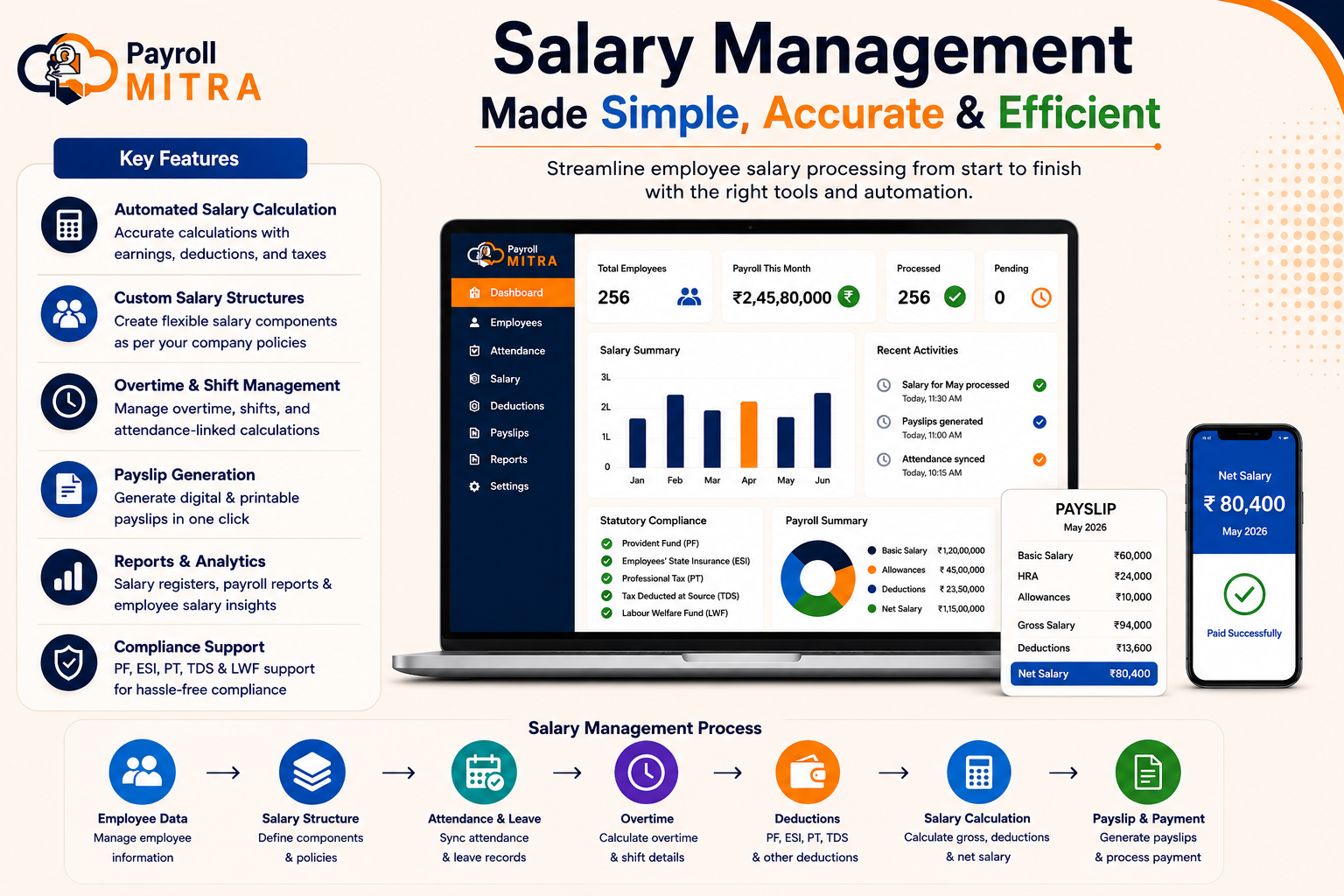
Managing employee salaries involves much more than calculating monthly pay. HR and payroll teams need to manage employee details, salary structures, attendance, leave, overtime, deductions, revisions, payslips, and salary payments accurately and on time.
As businesses grow, handling these activities through spreadsheets and manual processes can become time-consuming and difficult to manage. Even a small calculation or data-entry error can affect payroll accuracy and employee satisfaction.
An effective salary management process helps businesses organize employee compensation, streamline payroll activities, maintain accurate records, and reduce administrative workload. With the right salary management software, businesses can automate repetitive tasks and make employee salary processing more efficient.
What Is Salary Management?
Salary management is the complete process of managing and processing employee compensation within an organization. It covers the entire salary cycle rather than focusing only on monthly salary calculations.
The process typically begins with employee information and salary structure management and continues through attendance and leave adjustments, overtime calculation, deductions, net salary calculation, payslip generation, and salary payment.
A typical salary management cycle includes the following:
- Employee salary and personal data
- Salary structure and components
- Attendance records
- Leave adjustments
- Overtime and shift calculations
- Allowances and incentives
- Statutory and other deductions
- Net salary calculation
- Payslip generation
- Salary payment and reporting
A structured salary management process helps businesses handle employee compensation consistently while giving HR teams better control over payroll information.
Why Is Salary Management Important for Businesses?
Salary processing directly affects employees and business operations. Employees expect accurate salaries and timely payments, while businesses need organized payroll records for reporting, financial planning, and applicable compliance requirements.
An effective salary management process can help businesses
Improve Salary Calculation Accuracy
A structured process reduces the chances of calculation and data-entry mistakes during monthly payroll processing.
Reduce Payroll Errors
Attendance, overtime, leave, allowances, and deductions can all affect the final salary. Keeping these inputs organized helps reduce discrepancies in employee payroll records.
Save HR Time
Automating repetitive salary calculations and payroll activities allows HR teams to spend less time on administrative work.
Improve Employee Satisfaction
Accurate salary calculations and timely payslips provide greater transparency and can reduce payroll-related queries.
Maintain Organized Salary Records
Centralized salary information makes it easier to maintain employee records and access historical payroll data when required.
Simplify Reporting and Compliance
Organized payroll data helps HR teams prepare salary reports and manage applicable statutory deductions more efficiently.
Salary Management Process: Step-by-Step Guide
A complete salary management process involves multiple stages, from maintaining employee information to calculating salaries and generating payslips.
1. Employee Salary Data Management
Accurate employee information is the foundation of effective salary processing.
Employee salary records may include:
- Employee name and details
- Employee ID
- Designation
- Department
- Joining information
- Salary components
- Bank details
- Applicable deductions
Keeping this information centralized makes it easier to manage employee salaries and reduces dependency on multiple spreadsheets or separate records.
2. Salary Structure Creation
Employees may have different salary structures based on their role, designation, experience, grade, and company policies.
A salary structure may include:
- Basic Salary
- HRA
- DA
- Allowances
- Incentives
- Reimbursements
| Salary Component | Description |
| Basic Salary | Fixed salary component |
| HRA | House Rent Allowance |
| DA | Dearness Allowance |
| Allowances | Additional salary benefits |
| Incentives | Performance-based payments |
| Reimbursements | Eligible employee expenses |
A clearly defined salary structure helps businesses calculate employee earnings consistently.
3. Attendance and Leave Calculation
Attendance and leave records can directly affect an employee’s salary. Before finalizing payroll, HR teams may need to consider working days, leave, shifts, and overtime.
The salary management process may include:
- Working days
- Attendance records
- Paid and unpaid leave
- Shift schedules
- Overtime hours
- Attendance adjustments
Integrating attendance information with salary processing can reduce manual data entry and improve the consistency of payroll calculations.
4. Employee Salary Calculation
Once employee information, salary structures, attendance, leave, and overtime details are available, the salary calculation process can begin.
The process generally involves calculating total earnings, applicable deductions, and the final net salary.
Depending on the employee and applicable requirements, deductions may include:
- PF
- ESI
- Professional Tax
- TDS
- Other applicable deductions
The final salary is calculated after considering relevant earnings and deductions.
5. Payslip Generation and Salary Payment
After salary calculations are completed, businesses need to generate salary records and process employee payments.
This stage may include:
- Digital payslips
- Printable payslips
- Salary reports
- Bank transfer files
- Employee salary records
Digital salary records make it easier for HR teams and employees to access payroll information when required.
Key Components of Employee Salary Management
Different components contribute to an employee’s final compensation. The exact structure can vary based on company policies, employee roles, and applicable requirements.
| Component | Description |
| Basic Salary | Fixed salary component |
| HRA | House Rent Allowance |
| DA | Dearness Allowance |
| Incentives | Performance-based payments |
| Overtime | Payment for additional working hours |
| Deductions | PF, ESI, tax, and other applicable deductions |
Understanding these components helps HR teams create accurate salary structures and manage employee compensation efficiently.
Common Challenges in Manual Salary Management
Many businesses use Excel spreadsheets or other manual methods for salary processing. While these approaches may work for a small workforce, they can become difficult to manage as employee numbers and payroll requirements increase.
Excel-Based Salary Processing
Maintaining separate spreadsheets for employee details, attendance, leave, and salary calculations can make payroll management complicated.
Manual Calculation Errors
A formula error, incorrect data entry, or missed update can affect the final salary calculation.
Attendance Mismatch
When attendance information is maintained separately from salary records, HR teams may need to manually verify and update employee data.
Delayed Payslip Generation
Preparing payslips manually for multiple employees can consume significant HR time and delay payroll documentation.
Difficult Salary Revisions
Salary increments, promotions, revisions, and arrears can become difficult to track when employee information is spread across multiple files.
Reporting Problems
Preparing salary registers, employee salary reports, and other payroll reports manually can be time-consuming.
Compliance Calculation Issues
Calculating deductions such as PF, ESI, Professional Tax, and TDS manually requires careful handling and accurate employee data.
These challenges make automated salary processing a practical option for businesses looking to improve payroll efficiency and reduce repetitive HR work.
What Is Salary Management Software?
Salary management software is a digital solution that helps businesses automate and simplify employee salary processing.
Instead of relying entirely on spreadsheets and manual calculations, businesses can use software to centralize employee salary information and automate repetitive payroll activities.
A typical salary management workflow can connect the following:
Employee Data → Salary Structure → Attendance & Leave → Overtime → Deductions → Salary Calculation → Payslip
This creates a more organized salary processing workflow and reduces the manual effort required from HR teams.
Unlike a basic salary calculator, salary management software can support a broader payroll process, including employee records, salary revisions, deductions, payslips, reports, and salary-related data.
Benefits of Using Salary Management Software
Businesses can benefit from moving manual salary processing to an automated solution.
Automated Salary Calculation
Software can calculate employee salaries based on configured salary structures, attendance, overtime, and applicable deductions.
Faster Salary Processing
Automation reduces repetitive tasks and helps HR teams complete monthly salary processing more efficiently.
Reduced Manual Errors
Centralized employee information and automated calculations can reduce common data-entry and calculation errors.
Easier Employee Access to Salary Records
Depending on the software, employees may be able to access their salary information and payslips digitally.
Better Reporting
Businesses can generate salary registers, employee salary reports, and other payroll-related reports more efficiently.
Easier Salary Revisions
HR teams can update salary structures and manage revisions without manually rebuilding payroll calculations.
Improved HR Productivity
By reducing repetitive payroll activities, HR teams can dedicate more time to employee engagement, workforce planning, and other important HR responsibilities.
Features to Look for in Salary Management Software
The right salary management solution should be flexible enough to support different salary structures, employee requirements, and payroll processes.
Automated Salary Calculation
The software should calculate employee salaries based on salary structures, attendance, leave, overtime, and applicable deductions.
Custom Salary Structures
Businesses should be able to create salary structures according to their requirements, including:
- Basic Salary
- HRA
- DA
- Incentives
- Reimbursements
- Other allowances
This flexibility is useful when employees across departments or roles have different compensation structures.
Overtime & Shift-Based Salary Calculation
Businesses with multiple shifts or overtime requirements should look for software that supports shift-based and overtime salary calculations.
Connecting attendance and working-hour information with salary processing can reduce manual calculations and improve payroll consistency.
Salary Revision & Arrears Management
Employee salaries can change because of increments, promotions, role changes, or other business decisions.
A capable salary management system should make it easier for HR teams to manage salary revisions and pending adjustments or arrears.
Payslip Generation
The software should allow HR teams to generate digital and printable payslips without preparing each document manually.
This gives employees a clear record of their salary components, earnings, and deductions.
Salary Reports & Analytics
Reporting capabilities help HR teams and management access important salary information.
Useful reports may include:
- Salary Register
- Payroll Reports
- Employee Salary Reports
- Salary-related summaries and records
Payroll Mitra Salary Management Software
For businesses looking to simplify employee salary processing, Payroll Mitra provides an automated salary management solution designed to streamline payroll operations and reduce manual work.
Payroll Mitra brings key salary processing activities together in one system, helping HR teams manage employee salary information and payroll-related tasks more efficiently.
Key Capabilities of Payroll Mitra
- Automated Salary Calculation – Simplify monthly salary calculations using employee salary information.
- Custom Salary Structures – Create salary structures based on different employee requirements.
- Overtime & Shift-Based Salary Calculation – Manage salary calculations based on overtime and shift-related inputs.
- Salary Revisions & Arrears Management – Manage salary updates, revisions, and pending adjustments.
- One-Click Bank Transfer Files – Simplify the preparation of salary payment files.
- Digital & Printable Payslips—Generate payslips for employee access and record-keeping.
- Bulk Employee & Salary Data Import/Export – Manage large volumes of employee and salary information efficiently.
- Attendance Integration – Connect attendance-related information with salary processing.
- PF, ESI, PT & LWF – Support applicable payroll-related deductions and contributions.
These capabilities can help HR teams reduce repetitive payroll work, improve salary processing efficiency, and maintain more organized employee salary records.
Salary Management Software vs Excel Salary Processing
Excel can be useful for maintaining basic salary records. However, businesses with a growing workforce may need greater automation, centralized data, and reporting capabilities.
| Excel Salary Processing | Salary Management Software |
| Manual calculations | Automated calculations |
| Higher chance of errors | Reduced manual errors |
| Time-consuming | Faster salary processing |
| Limited reporting capabilities | Advanced reporting options |
| Difficult employee management | Centralized salary records |
| Manual salary revisions | Easier salary revision management |
| Multiple files may be required | Centralized salary information |
The right choice depends on business size, workforce, payroll complexity, and the level of automation required.
How to Choose the Right Salary Management Software?
Before selecting salary management software, businesses should evaluate whether the solution can support their current payroll requirements and future growth.
Business Size
Consider whether the software is suitable for your organization’s current size and payroll structure.
Number of Employees
The system should be capable of handling the current workforce while supporting future employee growth.
Attendance Integration
Integration with attendance data can simplify salary calculations and reduce repetitive data entry.
Compliance Support
Check whether the software supports applicable payroll deductions and requirements such as PF, ESI, Professional Tax, and LWF.
Reporting Features
Look for reporting options that allow HR teams to access salary registers, employee salary information, and payroll reports.
Data Security
Employee salary information is sensitive business data. Ensure that the software provides appropriate access controls and security measures.
Scalability
The solution should be able to support business growth without requiring a complete change in the payroll process.
Conclusion
Salary management is more than calculating an employee’s monthly salary. It involves managing employee information, salary structures, attendance, leave, overtime, allowances, deductions, revisions, payslips, payments, and salary records.
While manual salary processing may work for basic requirements, growing businesses can face challenges related to calculation accuracy, data management, reporting, and payroll efficiency.
Salary management software can help businesses automate repetitive salary processing tasks, reduce manual effort, improve accuracy, and give HR teams better control over employee compensation data.
With capabilities such as automated salary calculation, custom salary structures, overtime and shift-based calculations, salary revisions, payslip generation, attendance integration, and payroll deduction support, Payroll Mitra can help businesses streamline their salary processing workflow.
Simplify Your Salary Processing with Payroll Mitra
Automate salary calculations, payslips, deductions, and payroll operations with a smarter salary management solution.