

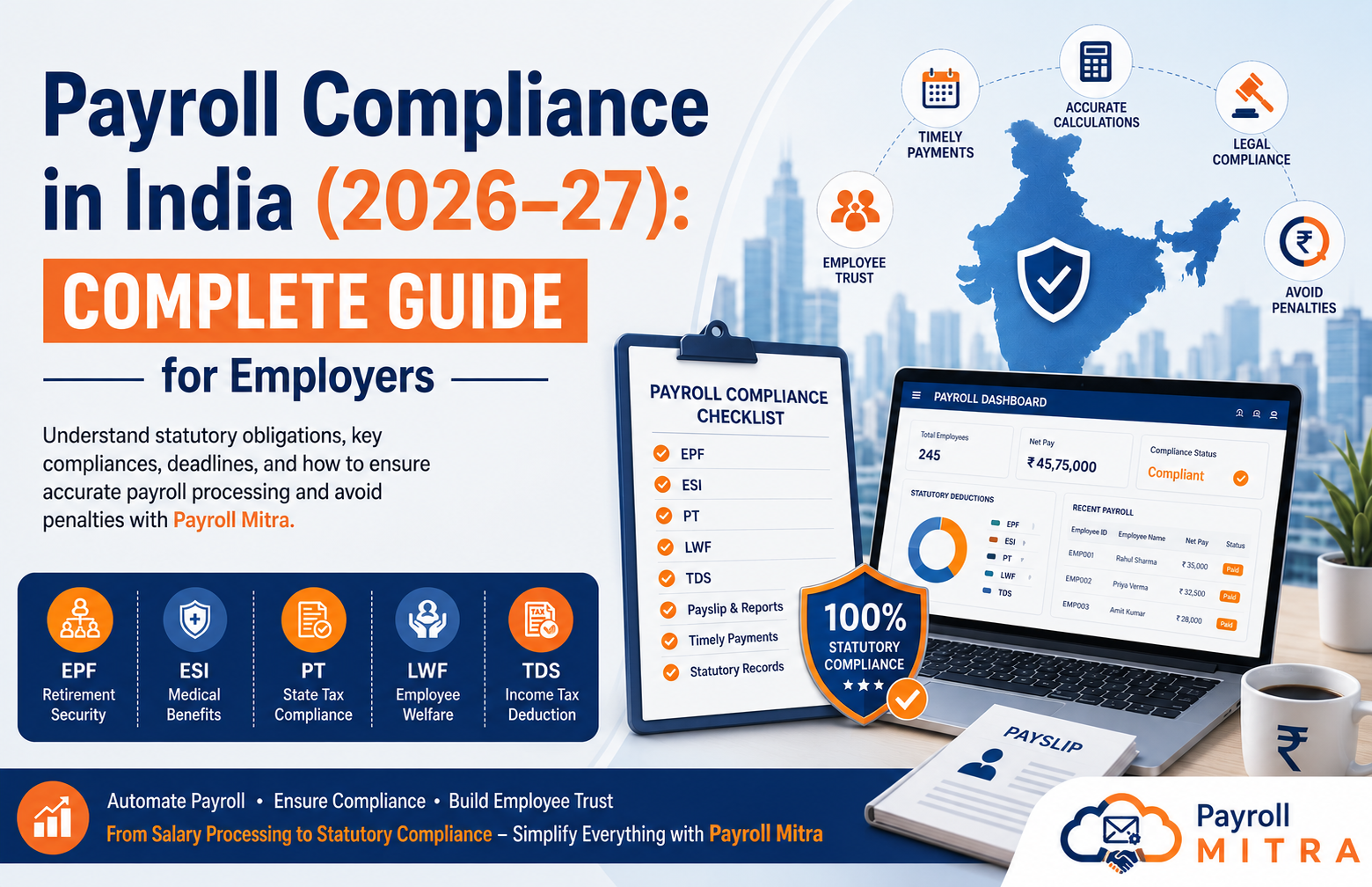
Payroll is much more than calculating salaries. Every business in India must ensure that employee salaries are processed accurately while complying with statutory regulations such as Employees Provident Fund (EPF), Employees State Insurance (ESI), Professional Tax (PT), Labour Welfare Fund (LWF), and Tax Deducted at Source (TDS). Missing compliance deadlines or making payroll errors can lead to penalties, employee dissatisfaction, and unnecessary administrative challenges.
Whether you’re a startup, SME, or large enterprise, maintaining payroll compliance is essential for smooth business operations and sustainable growth. As businesses expand, payroll management becomes more complex due to changing statutory requirements, increasing workforce size, and multiple compliance obligations.
A reliable payroll system not only ensures accurate salary processing but also helps businesses remain compliant with government regulations while reducing manual effort.
Payroll Compliance at a Glance
| Compliance | Frequency | Purpose |
| EPF | Monthly | Retirement savings |
| ESI | Monthly | Medical benefits |
| PT | Monthly | State tax |
| LWF | Monthly/Half-Yearly | Employee welfare |
| TDS | Monthly | Income tax deduction |
Maintaining these payroll compliances on time helps businesses avoid legal issues while ensuring employees receive accurate salaries and statutory benefits.
Why Payroll Compliance Matters
Payroll compliance is not just a statutory requirement—it is an essential part of running a successful business. Accurate payroll processing builds employee confidence, improves operational efficiency, and protects organizations from unnecessary penalties.
Some of the biggest benefits of maintaining payroll compliance include:
- Accurate salary processing every month
- Timely statutory deductions and payments
- Reduced risk of legal penalties
- Better employee trust and satisfaction
- Organized payroll records for audits
- Improved HR efficiency
- Reduced manual payroll errors
- Better financial planning
Businesses that rely on manual payroll calculations often spend significant time checking deductions, preparing reports, and correcting errors. As the workforce grows, these challenges become even more difficult to manage.
Automating payroll allows HR teams to focus on strategic activities instead of repetitive administrative work.
What is Payroll Compliance?
Payroll compliance is the process of managing employee salaries while following all applicable labour laws, tax regulations, and statutory obligations.
It involves:
- Salary calculation
- Employees’ Provident Fund (EPF)
- Employees’ State Insurance (ESI)
- Professional Tax (PT)
- Labour Welfare Fund (LWF)
- Tax Deducted at Source (TDS)
- Payslip generation
- Payroll reporting
- Maintaining statutory payroll records
A compliant payroll system ensures that salaries are processed accurately, statutory deductions are calculated correctly, and all payroll records are maintained for future reference and audits.
Businesses that fail to maintain payroll compliance may face financial penalties, delayed filings, compliance notices, and increased administrative workload.
Who Needs Payroll Compliance?
Payroll compliance is essential for every organization that processes employee salaries. Whether you’re a startup, SME, or large enterprise, complying with statutory payroll regulations helps ensure smooth business operations and avoids legal complications.
Payroll compliance is particularly important for:
- Small and Medium Businesses (SMEs)
- Startups with growing teams
- Manufacturing companies
- IT & Software companies
- Logistics & Supply Chain businesses
- Retail organizations
- Healthcare institutions
- Educational institutions
- Enterprises with multiple locations
Major Payroll Compliances in India
1. Employees Provident Fund (EPF)
Employees Provident Fund (EPF) is one of the most important social security schemes in India. Eligible employers are required to deduct EPF contributions from employee salaries and contribute the employer’s share according to statutory guidelines.
Proper EPF management ensures employees receive long-term retirement benefits while helping businesses remain compliant with labour regulations.
How Payroll Mitra Helps
Payroll Mitra simplifies EPF management by:
- Automatically calculating EPF deductions
- Maintaining employee contribution records
- Generating payroll-ready reports
- Reducing manual calculation errors
- Improving payroll accuracy
- Simplifying monthly payroll processing
Instead of relying on spreadsheets, Payroll Mitra automates EPF calculations, allowing HR teams to process payroll more efficiently.
2. Employees State Insurance (ESI)
Employees State Insurance (ESI) provides medical and social security benefits to eligible employees. Employers are responsible for identifying eligible employees, calculating contributions accurately, and maintaining proper records.
Incorrect calculations or missed deductions can create compliance issues and affect employee benefits.
How Payroll Mitra Helps
Payroll Mitra makes ESI management easier by:
- Automatically calculating ESI contributions
- Identifying eligible employees
- Maintaining employee records
- Generating statutory payroll reports
- Reducing manual payroll effort
- Improving payroll accuracy
With automated calculations, HR teams can process payroll confidently while minimizing compliance risks.
3. Professional Tax (PT)
Professional Tax (PT) is a state-level tax deducted from employees’ salaries in states where it is applicable. Since PT regulations differ from one state to another, employers must ensure they apply the correct tax slabs and maintain proper payroll records.
Managing PT manually across multiple locations can be time-consuming and increase the risk of payroll errors.
How Payroll Mitra Helps
Payroll Mitra simplifies Professional Tax management by:
- Automating PT calculations
- Supporting state-wise payroll configurations
- Maintaining statutory payroll records
- Generating compliance reports
- Reducing manual payroll effort
With Payroll Mitra, businesses can manage Professional Tax efficiently while minimizing calculation errors.
4. Labour Welfare Fund (LWF)
Labour Welfare Fund (LWF) is a statutory contribution applicable in selected Indian states to support employee welfare initiatives. Since contribution amounts and payment frequency vary from state to state, businesses need an organized payroll system to manage these deductions accurately.
Maintaining LWF compliance manually often leads to missed deductions or reporting errors, especially for businesses operating in multiple states.
How Payroll Mitra Helps
Payroll Mitra helps organizations manage LWF by:
- Calculating applicable LWF deductions
- Maintaining statutory payroll records
- Supporting compliance reporting
- Reducing manual calculations
- Improving payroll accuracy
Automation ensures that LWF deductions are handled efficiently without additional administrative effort.
5. Tax Deducted at Source (TDS)
Tax Deducted at Source (TDS) is an important component of payroll compliance. Employers are responsible for deducting applicable tax from employee salaries and maintaining accurate payroll records for taxation purposes.
Proper payroll management helps businesses maintain organized salary records and simplifies year-end payroll activities.
How Payroll Mitra Helps
Payroll Mitra supports payroll teams by:
- Maintaining accurate salary records
- Supporting payroll calculations
- Generating payroll reports
- Improving payroll accuracy
- Reducing manual payroll processing
With centralized payroll data, HR and finance teams can manage salary records more efficiently.
Common Payroll Compliance Challenges
Many organizations struggle with payroll compliance due to:
- Frequent regulatory changes
- Manual salary calculations
- Attendance mismatches
- Incorrect statutory deductions
- Delayed payroll processing
- Managing employees across multiple states
- Maintaining audit-ready payroll records
These challenges can increase payroll errors and administrative workload, making payroll automation an ideal solution.
Manual Payroll vs Payroll Software
As businesses grow, manual payroll processing becomes increasingly difficult. Managing salaries through spreadsheets often results in repetitive work, calculation errors, and delayed payroll processing.
A payroll management system automates repetitive tasks, reduces manual intervention, and improves overall efficiency.
| Manual Payroll | Payroll Software |
| Manual salary calculations | Automated payroll calculations |
| Higher risk of calculation errors | Improved payroll accuracy |
| Manual statutory deductions | Automated statutory calculations |
| Time-consuming payroll process | Faster payroll processing |
| Manual report preparation | Instant payroll reports |
| Difficult payroll audits | Organized payroll records |
| Multiple spreadsheets | Centralized payroll management |
Choosing payroll software enables businesses to process salaries faster while maintaining compliance and improving operational efficiency.
Benefits of Payroll Software
Modern payroll software does much more than calculate salaries. It helps businesses automate routine HR processes, improve payroll accuracy, and maintain statutory compliance.
Some of the major benefits include:
- Faster payroll processing
- Automated salary calculations
- Attendance integration
- Leave management
- Shift management
- Digital payslip generation
- Employee Self-Service (ESS)
- Payroll reports and analytics
- Reduced manual HR work
- Improved payroll accuracy
- Better compliance management
- Secure employee data
Instead of spending hours on repetitive payroll activities, HR teams can focus on employee engagement, workforce planning, and business growth.
Monthly Payroll Compliance Checklist
Following a structured payroll checklist every month helps businesses stay organized and avoid compliance-related issues.
Monthly Payroll Checklist
- Verify employee attendance
- Process monthly payroll
- Calculate EPF deductions
- Calculate ESI contributions
- Apply Professional Tax (where applicable)
- Calculate Labour Welfare Fund deductions
- Process TDS deductions
- Generate employee payslips
- Prepare payroll reports
- Transfer employee salaries
- Maintain statutory payroll records
Using a payroll checklist ensures that every payroll cycle is completed accurately and on time.
Why Choose Payroll Mitra?
Managing payroll manually can be time-consuming, error-prone, and difficult to scale as your business grows. Payroll Mitra is designed to simplify payroll and HR operations by combining payroll processing, statutory compliance, attendance management, leave management, and employee self-service into one cloud-based platform.
Whether you’re a startup, SME, or large enterprise, Payroll Mitra helps automate repetitive payroll tasks so your HR and finance teams can focus on strategic business activities instead of manual calculations.
With Payroll Mitra, businesses can:
- Automate monthly payroll processing
- Manage employee attendance and shifts
- Track leave and holidays
- Generate digital payslips
- Calculate statutory deductions accurately
- Maintain compliance-ready payroll records
- Generate payroll reports instantly
- Reduce manual HR workload
- Improve payroll accuracy
- Access payroll securely from anywhere
By replacing spreadsheets with automation, Payroll Mitra helps organizations process payroll faster while ensuring consistency and compliance.
Payroll Mitra Features
Payroll Mitra is an all-in-one Payroll & HRMS solution that brings payroll and employee management together on a single platform.
Payroll Management
Process employee salaries quickly with automated calculations and centralized payroll management.
Attendance Management
Track employee attendance accurately and integrate attendance directly with payroll processing.
Leave Management
Manage leave requests, approvals, and leave balances while reducing manual record keeping.
Shift Management
Create and manage employee shifts efficiently for better workforce planning.
Employee Self-Service (ESS)
Allow employees to access payslips, leave balances, attendance records, and other payroll information through a self-service portal.
Loan & Advance Management
Track employee loans and salary advances with automated deductions during payroll processing.
Payroll Reports
Generate salary registers, payroll summaries, and management reports instantly for better decision-making.
Compliance Reporting
Maintain statutory payroll records and generate compliance-ready reports with ease.
Notifications & Alerts
Keep employees informed with timely payroll, leave, and attendance notifications.
Simplify Payroll Compliance with Payroll Mitra
Managing payroll compliance manually can consume valuable time and increase the chances of calculation errors, missed deadlines, and compliance issues.
Payroll Mitra helps businesses automate payroll processing, statutory calculations, attendance management, leave management, compliance reporting, and employee self-service through a single integrated platform.
Instead of spending hours preparing payroll every month, HR and finance teams can process salaries faster, generate reports instantly, and maintain accurate payroll records with confidence.
By reducing manual effort and improving payroll accuracy, Payroll Mitra enables organizations to stay compliant while delivering a better payroll experience for employees.
Conclusion
Payroll compliance is a critical responsibility for every organization, regardless of its size or industry. From managing EPF, ESI, Professional Tax (PT), Labour Welfare Fund (LWF), and TDS to ensuring timely salary processing and maintaining statutory records, businesses must adopt a structured payroll process to avoid penalties and maintain employee trust.
As payroll regulations continue to evolve, relying on manual calculations and spreadsheets can lead to errors, delays, and unnecessary administrative work. Investing in an automated payroll solution not only improves efficiency but also helps businesses stay compliant with changing regulations.
Payroll Mitra is built to simplify every stage of payroll management. With features such as automated payroll processing, attendance integration, leave management, statutory deductions, digital payslips, compliance reporting, payroll analytics, and Employee Self-Service (ESS), Payroll Mitra enables businesses to process payroll accurately while reducing manual effort.
Whether you’re a startup, an SME, or a large enterprise, Payroll Mitra provides a secure, scalable, and efficient payroll solution that helps your HR and finance teams save time, improve accuracy, and focus on business growth.
Ready to Simplify Payroll?
Stop spending hours on manual payroll processing and compliance management.
Payroll Mitra helps you automate payroll, manage attendance and leave, generate digital payslips, maintain statutory compliance, and streamline HR operations—all from a single, cloud-based platform.
Book a Free Demo today and discover how Payroll Mitra can make payroll processing faster, more accurate, and completely hassle-free for your business.