

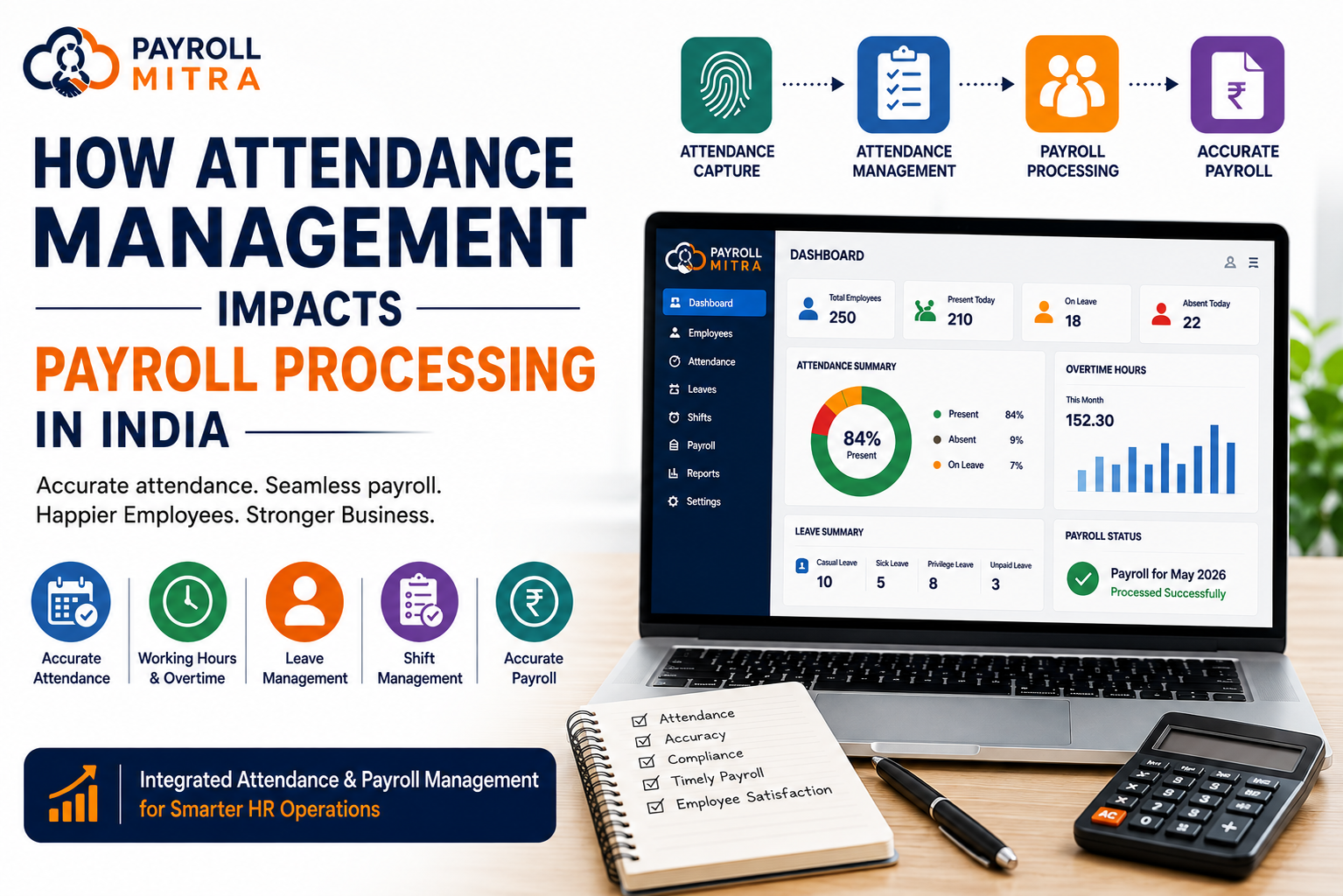
Payroll processing involves more than calculating an employee’s monthly salary. Accurate payroll also depends on reliable attendance data, including working days, leave, overtime, shifts, late arrivals, and other attendance records. When this information is managed manually or across separate systems, HR teams may spend additional time checking and correcting data before salaries can be processed.
For Indian businesses managing multiple employees, shifts, overtime, leave, or remote teams, connecting attendance with payroll can make salary processing more organized and efficient. Payroll Mitra brings these workforce and payroll activities together through an integrated payroll and HRMS platform.
What Is Attendance Management?
Attendance management is the process of recording, monitoring, and managing employee attendance and working hours. Instead of relying on registers or spreadsheets, businesses can use attendance management software to maintain employee records digitally.
Depending on the organization’s policies, an attendance management system can track the following:
- Employee check-in and check-out
- Present and absent days
- Working hours
- Paid and unpaid leave
- Late arrivals and early departures
- Overtime hours
- Employee shifts
- Attendance regularisation
- Remote and field employee attendance
Modern attendance software can collect this information through biometric devices, web applications, mobile devices, and location-based attendance methods.
The real value of attendance management comes when this data is connected with other HR processes, especially payroll.
Why Is Attendance Important for Payroll Processing?
Attendance is an important payroll input because it helps determine payable working days and, depending on company policies, other salary-related components.
An employee may have scheduled working days along with paid leave, unpaid leave, overtime, or shift-based working hours. Payroll teams need accurate records of these activities before processing salary.
A typical payroll workflow looks like this:
Attendance Data → Working Days → Leave/LOP → Overtime → Payable Days/Hours → Salary Calculation → Payroll Processing
If attendance records are incomplete or incorrect, HR teams may need to manually verify and correct them before finalizing payroll. Integrating attendance with payroll helps create a more consistent and efficient process.
How Attendance Affects Employee Salary Calculation
The impact of attendance on payroll depends on the organization’s salary structure, attendance policy, and applicable rules.
1. Working Days
Payable working days are an important input in salary processing. If an employee has fewer payable days than scheduled, the salary may need to be adjusted according to the organization’s policy.
Accurate attendance records help HR determine the employee’s actual attendance before payroll is processed.
2. Paid and Unpaid Leave
Leave records can directly affect payroll.
Approved paid leave is generally treated differently from unpaid leave or loss of pay (LOP). When an employee takes unpaid leave, the applicable salary adjustment may need to be reflected during payroll processing.
Keeping leave records updated helps prevent incorrect salary calculations.
3. Overtime
Employees in manufacturing, logistics, services, retail, and other shift-based businesses may work beyond their scheduled hours.
Where overtime is applicable under company policy and relevant rules, accurate attendance records can help HR identify approved overtime hours for payroll processing.
4. Shift Working
Businesses with fixed, rotating, or night shifts need accurate shift and attendance records.
Connecting shift schedules with attendance and payroll helps HR manage different working patterns more systematically and ensures relevant information is available during salary processing.
5. Late Coming and Early Leaving
Organizations may have specific policies for late arrivals and early departures.
Accurate records allow HR teams to apply these policies consistently during payroll processing instead of calculating adjustments manually.
6. Attendance Regularisation
Employees may occasionally forget to mark attendance or have incorrect check-in or check-out records.
Attendance regularisation allows employees or managers to correct legitimate discrepancies before payroll is processed. This helps prevent inaccurate attendance records from unnecessarily affecting salary calculations.
What Attendance Data Is Important for Payroll?
Not every attendance record has the same payroll impact. HR teams should review relevant attendance information before beginning the payroll cycle.
| Attendance Data | Possible Payroll Impact |
| Present Days | Helps determine payable working days |
| Absent Days | May affect payable days according to company policy |
| Paid Leave | Generally treated as paid days |
| Unpaid Leave/LOP | May result in salary adjustment |
| Working Hours | Helps determine worked or payable hours |
| Overtime Hours | Can support overtime calculation |
| Shift Details | Helps manage shift-related payroll requirements |
| Late/Early Records | May be considered according to company policy |
| Regularised Attendance | Helps maintain accurate payroll inputs |
The treatment of attendance data depends on the organization’s policies, salary structure, and applicable employment and payroll requirements.
How Does Attendance-Payroll Integration Work?
When attendance and payroll are managed separately, HR teams may need to export, verify, modify, and re-enter information before processing salaries.
With attendance and payroll integration, relevant attendance information can move into the payroll workflow with less manual intervention.
A typical process includes:
Step 1: Employee Check-In and Check-Out
Employees record attendance using the available attendance method.
Step 2: Attendance Data Collection
The system records attendance status, working hours, and assigned shifts.
Step 3: Leave and Attendance Updates
Approved leave, absences, and attendance regularisation are updated in employee records.
Step 4: Overtime and Shift Information
Approved overtime and applicable shift information are recorded.
Step 5: Payroll Inputs
Relevant attendance information becomes available for payroll processing.
Step 6: Salary Calculation
The payroll system uses attendance information along with the employee’s salary structure and applicable rules to process salary.
Step 7: Reports and Payslips
After payroll processing, businesses can generate relevant reports and employee payslips.
This connected workflow reduces repeated data entry and makes it easier for HR teams to review payroll-related information.
Problems With Managing Attendance and Payroll Separately
Using disconnected systems can create several challenges during each payroll cycle.
Manual Data Entry
Transferring attendance information into payroll manually takes additional time and increases the possibility of data-entry errors.
Data Mismatch
Attendance and payroll records may contain different information. For example, approved leave may be updated in the attendance system but missed during payroll processing.
Overtime Errors
When overtime is maintained separately in spreadsheets or manual records, HR teams may need to verify the information before including it in payroll.
Leave and LOP Mistakes
Incorrect or outdated leave records can affect payable days and salary adjustments.
Delayed Payroll Processing
Reconciling attendance, leave, overtime, and salary data manually can delay payroll finalization.
Limited Visibility
When attendance, leave, shifts, and payroll are stored separately, HR managers may find it harder to get a complete view of an employee’s payroll-related information.
Benefits of Integrating Attendance With Payroll
Connecting attendance with payroll can simplify routine HR activities and improve the consistency of payroll inputs.
1. More Accurate Payroll Inputs
Relevant attendance information is available within the payroll workflow, reducing unnecessary manual data transfers.
2. Less Administrative Work
HR teams spend less time collecting, checking, and re-entering attendance information.
3. Faster Payroll Processing
With attendance, leave, overtime, and shift information organized in one workflow, payroll teams can focus on reviewing exceptions and finalizing salaries.
4. Better Overtime Tracking
Approved overtime can be maintained as part of the broader workforce management process.
5. Improved Leave Management
Attendance and leave records can be managed together, making it easier to identify relevant paid and unpaid attendance adjustments.
6. Reduced Payroll Errors
Using consistent employee data across attendance and payroll can reduce errors caused by duplicate entry or outdated records.
7. Better Employee Experience
Accurate attendance and payroll records can reduce salary-related queries and give employees better visibility into attendance and payslips.
Attendance Management for Different Types of Employees
Attendance requirements vary depending on how employees work.
Office Employees
Office-based employees generally follow regular schedules and may use biometric, web-based, or other digital attendance methods.
Shift-Based Employees
Manufacturing, logistics, retail, and similar businesses may operate fixed, rotating, or night shifts. These employees often require detailed shift and overtime tracking.
Remote Employees
Remote employees may use mobile or web-based attendance instead of traditional biometric methods.
Field Employees
Field employees work across different locations. Depending on business requirements, geo-tagged or location-based attendance can help organizations monitor attendance more effectively.
For businesses with multiple workforce types, integrating attendance with payroll can simplify the management of different working patterns and payroll inputs.
What to Look for in an Attendance and Payroll System?
Businesses choosing attendance management software should look beyond basic check-in and check-out functionality.
Important capabilities may include:
- Biometric attendance
- Web-based attendance
- Mobile attendance
- Geo-tagged attendance
- Remote employee attendance
- Shift management
- Overtime tracking
- Leave management
- Attendance regularisation
- Payroll integration
- Employee self-service
- Attendance and payroll reports
- Payroll compliance support
The right features depend on workforce size, working model, internal policies, and payroll requirements.
How Payroll Mitra Connects Attendance With Payroll
Payroll Mitra Attendance Management Software helps businesses maintain payroll-ready attendance data through biometric, web, and mobile attendance integrations. It supports attendance tracking along with shift-wise attendance, late-in and early-out records, attendance regularization, overtime calculation, geo-tagged remote attendance, and attendance reports.
By connecting these workforce processes with payroll, businesses can reduce repetitive data entry and maintain more consistent information for salary processing.
Attendance → Shifts → Leave/Regularisation → Overtime → Payroll-Ready Data → Salary Processing
Payroll Mitra brings attendance, leave, shift, overtime, and payroll into a connected workflow, helping HR teams manage employee information more efficiently.
Attendance Management vs Manual Attendance Tracking
| Factor | Manual Attendance | Attendance Management Software |
| Attendance Recording | Registers/Spreadsheets | Digital methods |
| Data Entry | Mostly manual | More automated |
| Overtime Tracking | Manual verification | System-based tracking |
| Leave Updates | Separate/manual | Centralised |
| Shift Management | Often spreadsheet-based | Digital shift management |
| Payroll Data | Manual transfer | Can be integrated |
| Reports | Manually prepared | System-generated |
| Remote Attendance | Difficult to manage | Mobile/web-based options |
| Data Visibility | Limited | Centralised |
The purpose of attendance software is not simply to replace a register. It creates a more structured workforce management process where attendance data can support HR and payroll activities.
How to Improve Attendance and Payroll Accuracy
Businesses can improve the overall process with a few practical steps.
Define Clear Attendance Policies
Employees should understand working hours, shift schedules, leave rules, overtime policies, and attendance regularisation procedures.
Use a Centralised System
Keeping attendance, leave, shifts, and payroll information in connected systems can reduce unnecessary data duplication.
Review Exceptions Before Payroll
HR teams should check missing punches, unusual attendance records, overtime, leave discrepancies, and other exceptions before processing payroll.
Automate Repetitive Tasks
Automation reduces manual data entry and saves time during every payroll cycle.
Maintain Accurate Employee Records
Salary structures, attendance records, leave information, and other payroll-related details should be kept updated.
Give Employees Access to Relevant Information
Employee self-service features can allow employees to view attendance, leave, and payslips without depending on HR for every request.
Why Attendance and Payroll Integration Matters for Indian Businesses
Indian businesses often manage different employee categories, salary structures, shifts, leave policies, and statutory payroll requirements. As the workforce grows, handling these activities manually can become increasingly difficult.
An integrated attendance and payroll software solution can connect employee attendance with salary processing while reducing repetitive administrative work.
For businesses managing shift workers, field employees, remote teams, or growing workforces, this integration can provide better control and visibility over payroll-related attendance data.
Conclusion
Accurate payroll starts with accurate employee data. Attendance records can influence payable days, leave adjustments, overtime, shifts, and other payroll inputs. When these records are maintained manually or across disconnected systems, HR teams may spend additional time reconciling information and correcting errors.
Attendance management software helps businesses organize working hours, leave, shifts, overtime, and attendance records. When connected with payroll, this information can become part of a more streamlined salary-processing workflow.
Payroll Mitra combines payroll, attendance, leave, shift, overtime, employee management, reporting, and compliance capabilities to help Indian businesses manage their workforce and payroll more efficiently.
Simplify Attendance & Payroll With Payroll Mitra
Manage attendance, leave, overtime, shifts, and payroll through one connected platform designed for Indian businesses.
Automate payroll, reduce manual work, improve data accuracy, and manage your workforce more efficiently.
Get Started With Payroll Mitra Today.